

Beyond Calendar Moments: How Organisations Turn Belonging Into a Movement.

Our new report explores how organisations can build sustainable culture change through year-round action.

Every year, organisations cycle through a familiar rhythm: Pride in June, Black History Month in October (in the UK), International Women’s Day in March, Disability History Month, Trans Day of Visibility, South Asian Heritage Month, Mental Health Awareness Week and on it goes.
These dates matter. They uplift stories, generate visibility, and offer structured opportunities to celebrate communities that have historically been marginalised.
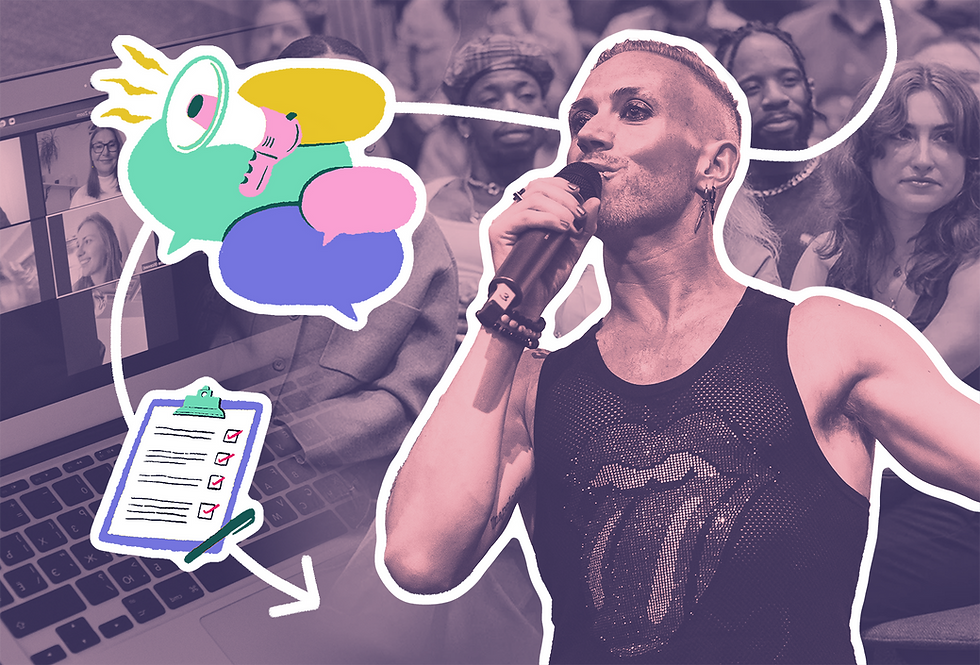
With this in mind, We Create Space & Soho House partnered to bring thought leaders in London together to explore the concept of building movements in organisations rather than focus on calendar moments. This group of experts ranged from large global organisations, cultural institutions, community organisers, and represented a diverse group of roles within these companies.
What was clear throughout the roundtable discussion was these moments alone are not enough. They cannot hold the weight of the lived experiences they are meant to honour, nor can they drive the organisational change that true inclusion and belonging requires.
Simply put:
“If it is a moment, inevitably it is going to go away.” - Tolu Osinubi, Director of Engineering, AI & Data
The challenging question organisations must now confront is: How do we turn these moments into a sustainable movement?
What follows captures the core themes from our discussion and concludes with three practical steps for any organisation to use, regardless of size, maturity, or industry.
1. Moments Create Visibility but Without Year-Round Action, They Fail

Participants were unanimous, calendar moments can spark attention, but they are insufficient on their own. Several themes emerged:
Lack of Emotional Investment
When inclusion activities are limited to single calendar moments, they generate awareness but not understanding. People outside those communities may attend an event or read an email, but they often aren’t asked to explore the underlying challenges their colleagues face.
“It’s a lack of emotional investment… if it’s just a one time hit, then you get people within the community who can come together for that one moment and really embrace it, but wider emotional investment from other communities… lacks.” - Aidy Smith, TV Presenter, Broadcaster & Neurodiversity Advocate
Without emotional investment, behaviour doesn’t change. Attitudes don’t shift. The work evaporates as quickly as the moment passes.
Celebration Without Understanding
Too often, organisations jump straight to celebration, colourful visuals, themed events, social posts, instead of carving out genuine time to understand the experiences of the people the moment is meant to honour.
“Almost nothing sticks in people’s minds if you do it once or for a week or for a month.” - Kyle Ireland, Head of DEI & People Experience
A Pride flag in June means little if LGBTQ+ employees feel invisible the rest of the year. An IWD panel means little if the gender pay gap remains unexamined. A Black History Month campaign means little if leadership pipelines remain unchanged.
“Celebrating a cultural or identity difference is a lot different than spending a year understanding the issues that these communities are facing and then working to solve them.” - Jamila Brown, Founder, Light/Work
Moments Don’t Fix Systems
Calendar activations tend to fall under “culture work” like events, comms, celebrations. However sustainable inclusion comes from the marriage of culture and structure: policies, reporting, accountability, promotion pathways, representation goals, pay equity, learning systems, and leadership expectations.
Most organisations currently pour energy into culture moments because they are tangible and easy to produce. But the deepest issues employees face like discrimination, bias in processes, lack of psychological safety and inequitable progression, require structural change.
“There’s a phrase… ‘visibility without protection is a trap.’” - Marty Davies - Founder & CEO Trans+ History Week CIC
The Power of Emotional Storytelling
Participants shared repeatedly that stories are what drive connection, empathy, and action, not data points alone. Moments offer an opportunity to tell those stories, but unless the storytelling continues, the emotional connection fades.
Marty Davies, founder of Trans+ History Week, described Trans+ History Week as “a gateway”, using celebratory and narrative-rich programming to pull people into deeper year-round engagement. Another participant emphasised that people remember stories 20x more than facts alone. Moments should be seen as a spark but they must be connected to something bigger.
2. Barriers That Stop Inclusion From Becoming a Movement

Throughout the roundtable, barrier after barrier surfaced. Some were practical, some cultural, some political, others emotional but all impacted the organisation’s ability to create sustained inclusion work.
Budget and Resourcing
Budget appeared repeatedly, and for good reason:
“Budget is everything. It’s the difference between paying lip service to something and an organisation showing that they actually care.” - Tolu Osinubi, Director of Engineering, AI & Data
Data
Budget is a signal of seriousness.
It distinguishes performative talk from sustained commitment.
It allows for expertise to be compensated, not exploited.
It funds programming, data, learning, and community support.
Yet budgets for inclusion work are often non-existent or tied only to calendar moments and centralised within HR without strategic alignment. They’re often viewed as a “nice to have” but not essential, and regularly face cuts in times of financial pressure.
Small organisations, in particular, struggle with where to begin. Participants noted that if budgets truly don't exist, some form of value exchange or in-kind support can be explored but this must never become an excuse to avoid paying marginalised people for their labour.
“Woke Risk” and Reputational Fear
Participants spoke candidly about organisational fear: Fear of backlash, negative media attention, doing the wrong thing, and fear of “politicising” the workplace.
“Any time I say, ‘We’re just going to add our pronouns policy,’ the anxiety… there is a little bead of sweat going down directors’ heads…” - Inclusion Practitioner in Arts & Culture
This fear often leads to paralysis or, worse, the rolling back of previously established inclusion efforts. Even progressive comms teams are feeling this tension. The risk of backlash is real, but participants pointed to an important truth: The reputational risk of not being inclusive is growing faster. Customers, employees, and the public are increasingly aligned with organisations who act on their values.
“There is hesitancy in perceived organisational reputational risk… wondering who’s coming for us next.” - Inclusion Practitioner in Arts & Culture
Lack of Data (and Misuse of It)
Data is essential for structural change but organisations often:
don’t collect it,
can’t collect it because there is a lack of trust and/or legal barriers
don’t know how to interpret it,
misuse it to defend inaction,
lack the confidence to analyse it through an intersectional lens,
or fail to include marginalised voices in survey design.
Participants warned that data without context becomes dangerous. For example, using national census data to evaluate representation in a London-based company is misleading. Data must be contextualised, comparative, and tied to decision-making.
Inclusion Work Is Often Unpaid, Unsupportive, or Invisible
“More often than not, the people responsible for doing [inclusion work] are not paid for what they are doing… They’re neurodivergent, LGBTQI+, from underrepresented ethnic communities…” - Aidy Smith, TV Presenter, Broadcaster & Neurodiversity Advocate
ERGs, network leads, lived-experience advisors, project teams, and ambassadors often:
do the work voluntarily,
manage it alongside their full-time job,
burn out,
face emotional labour without support,
or are expected to fix systemic issues without authority.
This model is unsustainable and deeply inequitable.
Organisational Structure: The Importance of Role Clarity & Accountability
Participants were aligned: When inclusion is not assigned to a clear role or department, accountability disappears.
“If DEI is everyone’s job, it’s absolutely no one’s job.” - Inclusion Practitioner in Arts & Culture
But where should it sit? Some argued for the CEO. Some for COO. Some for Social Impact, some for Legal, some for People & Culture. Most agreed it requires both:
A strategic function (company-wide influence, connection to business goals, culture shaping)
An operational function (policies, processes, employee guidance, data collection, systems change)
“HR’s job is to protect the business… DEI gets caught by that. Decoupling from HR takes away that difficulty.” - Tolu Osinubi, Director of Engineering, AI & Data
And a crucial reminder surfaced: Culture is modelled from the top. If leaders don’t care or appear not to then everything else becomes harder.
3. The Case for Inclusion Must Be Hardwired Into Business Strategy

Participants emphasised that inclusion cannot rely solely on morality or ethics, not because those values aren’t important, but because they do not motivate organisational decision-makers at scale.
Businesses prioritise revenue, profitability, brand relevance, innovation, talent attraction, talent retention and risk mitigation, but research consistently shows the work of inclusion directly improves every single one of these outcomes.
“The priority from leadership is slipping because the pressure externally isn't on anymore. So it's not that they don't care anymore. They know it’s nice to do…but this isn't the most urgent thing that you can come to leaders with. Because often what they are really struggling with is budgets and sales, and this and that and other things.” - Jamila Brown, Founder, Light/Work
Examples shared during the discussion included:
Employee belonging correlates with higher creativity, decision-making quality, and innovation.
Advertising with diverse representation leads to higher sales.
Brands that authentically invest in communities improve customer trust and loyalty.
Gen Z and younger millennials actively choose organisations aligned with their values.
Inclusion improves operational efficiency by decreasing conflict, attrition, and inequities.
A more diverse company reaches more diverse audiences, expanding revenue potential.
Yet, despite this overwhelming evidence, leaders often fail to draw a clear line between inclusion and business performance. Inclusion is not a side project. It is not a feel-good initiative. It is a driver of competitive advantage and companies who embrace this will outperform those who don't.
4. What It Takes to Shift From Moments to Movement

Throughout the discussion, a set of deeper shifts emerged, shifts organisations must make if they want inclusion to move beyond surface-level activation.
A. Move from celebration to purpose
A Pride-themed logo change does not create belonging. A Black History Month panel does not challenge structural barriers. A mental health webinar cannot replace meaningful wellbeing support.
Purpose comes from:
addressing real barriers people face,
investing in emotional narratives,
making visible what is often invisible,
connecting actions to strategy,
funding the work year-round.
“We spent probably the past three or four years building, both engagement and belonging as our kind of key metrics, because we essentially said, we don't want to be just a diverse organization. We want to be one where everyone inside the organization is reaching similar outcomes for similar performance and then it's determining how we go to each function and actually make that happen and implement that.” - Kyle Ireland, Head of DEI & People Experience
B. Move from reactive to proactive
Many organisations treat inclusion like a fire extinguisher, breaking the glass only when something goes wrong. Participants identified that proactive inclusion can look like:
transparent policies,
ongoing education,
thoughtful comms reviews,
lived-experience-led design,
regular data analysis,
positioning inclusion as a business enabler,
embedding inclusion into every strategy, not keeping it siloed.
Role clarity and accountability
C. Move from safe to brave
Participants emphasised that real progress requires:
asking bolder questions,
naming realities leaders are uncomfortable with,
challenging outdated narratives about risk,
making non-performative commitments,
accepting discomfort as part of the growth process.
“We need to be braver in asking how we can navigate objectives together.” - Aidy Smith, TV Presenter, Broadcaster & Neurodiversity Advocate
Three Practical Tips to Transform Moments Into Movements
These tips are drawn directly from the insights shared during the roundtable and are intentionally designed to be relevant for organisations of any size, sector, or maturity.
1. Build a Year-Round Narrative Strategy (Not a Calendar Strategy)
Stop thinking in months. Start thinking about how to communicate and demonstrate your value proposition through a lens of belonging.
This means:
Mapping the stories you want to tell across the year.
Ensuring every moment builds on the last, connected by purpose and values.
Including emotional storytelling, not just facts.
Involving people with lived experience in co-design, not just approval.
Linking each story to a business priority (talent, brand, product, culture, revenue).
Narratives drive understanding. Understanding drives empathy. Empathy drives action. And action drives behavioural and culture change.
“Greater creativity, innovation, and decision-making are all seen in organisations where employees feel a sense of belonging.” - Marty Davies, Founder & CEO Trans+ History Week CIC
2. Start With One Structural Change and Do It Properly
Pick one meaningful structural issue your organisation currently faces and commit to solving it.
Participants shared these examples:
Reviewing policies for inclusiveness and modernisation.
Introducing a formal mentoring programme supported by leadership.
Updating recruitment processes to eliminate bias.
Establishing a belonging or engagement metric and measuring it consistently.
Formalising ERG roles and compensating them for their labour.
Creating company-wide expectations for inclusive communication.
“We have to consider not just what the goals are but why we have set those goals." - Jamila Brown, Founder, Light/Work
3. Build Relationships With the Right Internal Stakeholders
Participants were crystal clear: Inclusion cannot succeed in a vacuum. We need to identify and build long-term relationships cross-functionally and establish ways to partner. That could include:
Comms: Shape messaging & co-author inclusive communications
Finance: Approve budgets, validate ROI, allocate resources
Legal & Compliance: Ensure policies are inclusive, safe, and compliant
Operations: Embed inclusion into daily workflows & remove blockers
Social Impact / ESG: Connect goals to ESG strategy and community impact
People & Culture: Embed inclusion across the employee lifecycle & support ERGs
Data Teams: Collect, analyse, and interpret inclusion data for decision-making
Key Executives: Set tone from the top, champion inclusion and belonging, approve strategic direction
When you build relational infrastructure, inclusion work moves faster, encounters less friction, and becomes embedded across the business not isolated within one department.
“I think if we're talking about how we convince more senior stakeholders and the C-Suite, how we use data and also contextualize data matters because many don’t know how to interpret it without context.” - Tolu Osinubi, Director of Engineering, AI & Data
Conclusion: Moments Are the Spark. Movements Are the Work.
This roundtable revealed a truth many practitioners already feel but few organisations fully embrace: Moments matter but only when they are rooted in purpose, fuelled by storytelling, supported by structure, and reinforced all year round.
A movement:
survives beyond a logo change,
transforms culture and systems,
distributes responsibility and authority,
prioritises emotional connection,
invests in the people it serves,
evolves with the organisation,
and aligns directly with business success.
The future of inclusive work requires courage, strategy, emotional honesty, and organisational clarity. It requires leaders willing to be uncomfortable, employees empowered to contribute meaningfully, and practitioners armed with data, narrative, and influence.
Calendar moments can be beautiful catalysts but the real transformation comes from what we choose to do the other 11 months of the year.
Lead Author: Jon-Paul Vicari
Co-Authors: Neil Hudson-Basing and Jua O’Kane
Contributors:
Aidy Smith (he/him) - TV Presenter, Broadcaster & Neurodiversity Advocate (@Sypped and @DisLabeled)
Tolu Osinubi (she/her) - Director of Engineering, AI & Data (@FollowTolu)
Marty Davies (she/they) - Founder & CEO Trans+ History Week CIC (@marjoda and @transhistoryweek)
Jamila Brown (she/her) - Founder Light/Work (@jamilafaye and @wedolightwork)
1 Anonymous Inclusion Practitioner
Moderators: Neil Hudson-Basing (he/him) Community and Events Director at We Create Space & Jon-Paul Vicari (he/him) Managing Director at We Create Space
Location Partner: Soho House
While you're here...
Did you know we consult with Businesses, ERGs and Change-Leaders providing bespoke corporate solutions? Through consultancy we design shared learning experiences, produce DEI insights and craft bespoke content that support individuals with strengthening their roles as change-agents within their communities and organisations. Find out more here.
We also organise FREE community events throughout the year! We offer a variety of ways to get involved - both online and in person. This is a great way to network and learn more about others' experiences, through in-depth discussion on an array of topics. You can find out what events we have coming up here. New ones are added all the time, so make sure you sign up to our newsletter so you can stay up to date!


Comments